%20(1).jpg)
What is Cat ID (Coming Soon)?Updated 6 months ago
Cat ID – Facial Recognition for Your Cat (Coming 2026)
What is Cat ID?
Cat ID is like Face ID on your iPhone, but for cats. When a cat approaches your Flappie, our AI camera recognizes their unique facial features — whisker patterns, nose shape, eye spacing — and decides whether it's one of your cats or a stranger. If it's your cat, the door opens. If it's the neighbor's cat, it stays locked.
How Does It Work?
Your Flappie automatically learns your cats' faces during their first few days of use. Our neural network creates a unique "facial fingerprint" — a mathematical representation of your cat's face that stays consistent across different lighting conditions and angles. After this learning period, only cats with recognized faces can enter.
No setup required on your end. Just let your cats use the Flappie as usual, and the system does the rest.
Why Vision Instead of Microchips?
This is probably the most common question we get — so let's address it openly.
We respect what microchips do well
Microchips play an important role in pet identification. If your cat goes missing, a microchip is often the fastest way for a shelter or vet to reunite you with your pet. That infrastructure — the databases, the scanners at vet clinics — is genuinely valuable.
We are not arguing against microchipping your cat. If your cat isn't chipped yet, we'd actually encourage you to consider it for their safety.
But microchip-based cat flaps have real limitations
Traditional microchip cat flaps rely on RFID reader technology that dates back to the 1980s. For the specific task of controlling cat flap access, this approach comes with several issues:
- It only works for chipped cats — and millions aren't (more on that below)
- Metal door frames and aluminum can interfere with the signal, causing read failures
- Chips can migrate inside the body over time, moving away from the scan zone
- Each cat needs a veterinary procedure — a minor one, but still an invasive step that costs CHF 50–100 per cat
We decided to skip this technology entirely and build something better: non-invasive recognition that works for ALL cats, chipped or not. No surgery. No collar. No magnet. Just your cat being your cat.
The Compliance Gap: Theory vs. Reality
You might think microchipping is universal by now, especially where it's mandatory. The reality tells a different story.
United Kingdom: England made cat microchipping mandatory in June 2024. Despite this, the Cats Protection CATS Report 2025 found that 22% of UK cats still aren't microchipped — that's roughly 2.2 million cats. The figure has barely moved since the law was introduced (it was 25% unchipped in 2024).
Portugal: Microchipping became mandatory for cats in 2022. Yet a peer-reviewed study published in 2023 found that only 12% of cats were actually microchipped — meaning 88% of cats remain without a chip despite the legal requirement.
EU-wide: According to the EU Dog & Cat Alliance, mandatory cat microchipping only exists in a small number of EU member states. Even in countries where dogs must be chipped, cats are often excluded. Enforcement varies widely.
The conclusion is clear: a cat flap that only works with microchipped cats excludes a huge portion of the cat population — even in countries where chipping is the law.
The Industry Is Moving Toward Non-Invasive ID
We're not the only ones seeing this shift.
Petnow, a South Korea-based startup backed by Purina's UNLEASHED program, has built a biometric pet ID app that uses nose prints for dogs and facial features for cats — no microchip needed. Their technology has launched across Australia, New Zealand, and globally, and they're positioning it as a complement and eventual alternative to traditional microchipping.
This is exactly the direction the pet tech industry is heading — from invasive hardware implants toward AI-powered, vision-based identification. The difference with Flappie? We build this directly into the cat flap itself. No separate app, no manual scanning. It just works, every time your cat walks up to the door.
Ethical Considerations
We believe pet technology should put the animal's wellbeing first:
- Non-invasive: No surgery, no implant, no collar, no magnet
- Inclusive: Works for every cat regardless of chipping status
- Privacy-first: Recognition happens on-device — your cat's data isn't sent to the cloud for identification
- No additional cost per cat: Add as many cats to your household as you want
Technical Validation
Our neural network creates unique "facial embeddings" — mathematical fingerprints of each cat's face. Testing on over 1,000 cat image pairs shows strong results:
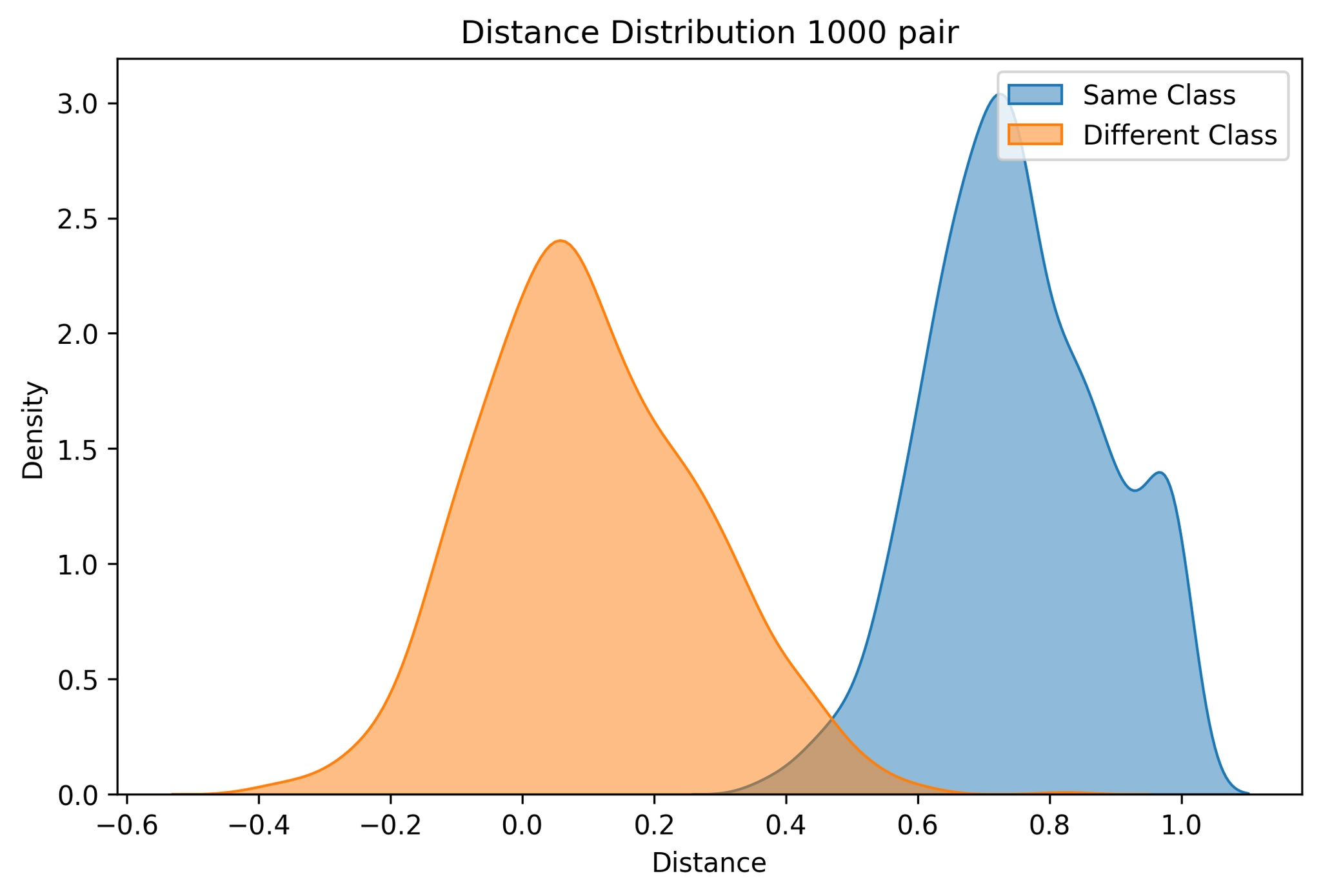
- Same cat, different times: High similarity scores (~0.8), meaning the system reliably recognizes the same cat
- Different cats compared: Low similarity scores (~0.05), meaning the system clearly distinguishes between cats
- Key achievement: Clear separation between the two distributions with minimal overlap
Each cat's biometric signature remains consistent across different lighting conditions and angles.
Where We Are Today
Cat ID is currently in active development with promising early results. Our first working models are already running successfully in test environments, achieving 87% accuracy — and improving continuously as our dataset grows.
We expect to roll out Cat ID to Flappie owners in 2026. We'll keep you updated on progress through the app and our newsletter.
What Comes Next
Cat ID is just the beginning. The same frontal camera perspective that enables facial recognition also opens the door to future capabilities:
- Behavioral analysis: Understanding your cat's patterns and routines
- Health monitoring: Research shows that subtle changes in facial expressions — ear position, pupil size, whisker position — can indicate pain or illness before humans notice. Our long-term vision is to give cat owners early insights into their cat's wellbeing.
Every Flappie in the field contributes to making these systems smarter. Every cat helps us understand all cats better.
Have questions about Cat ID? Reach out to us at [email protected] — we're happy to talk about it.